| Status: | Active, open to new members |
| Coordinator: | |
| Group email: | Social History group |
| When: | Monthly on Monday mornings 10:00 am-12:00 pm 3rd Monday |
| Venue: | Colville House |
If you are interested in joining or wish to learn more about our activities please contact the groups Co-ordinator using the link above or phone 07767 431565
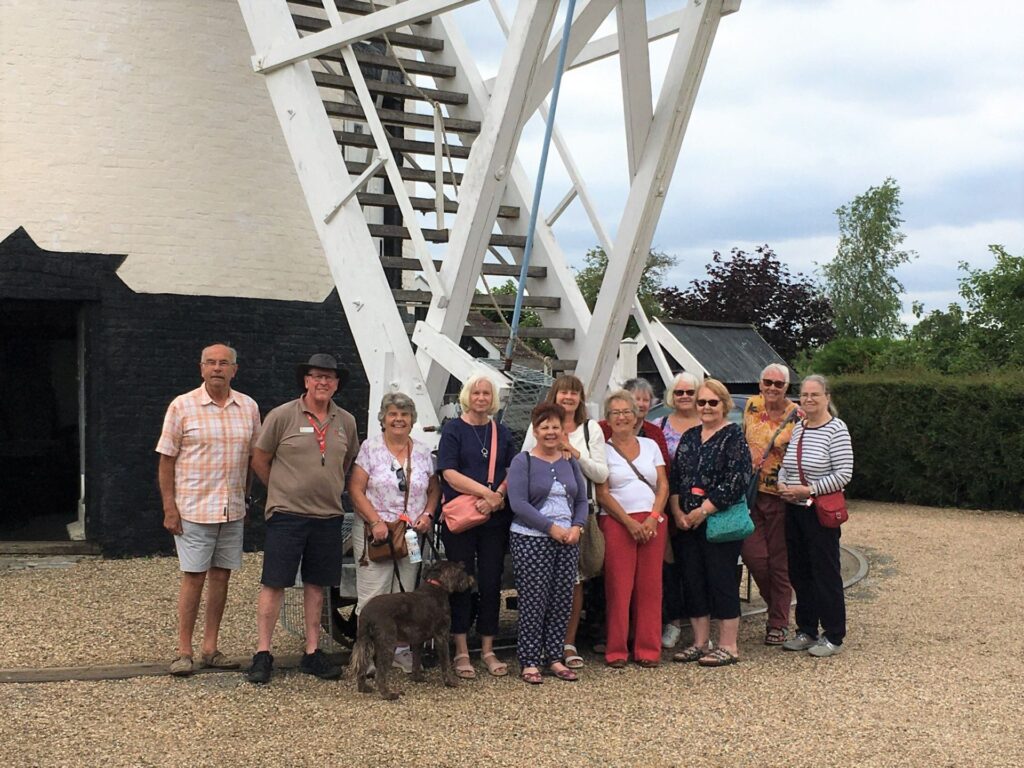
The Social History Group is a thriving, friendly group.
Our members participate in and contribute to vibrant and lively discussions, investigate interesting topics and exchange views and experiences. The programme for the year is democratically planned by the group, click the link in the side bar to see what we have planned for the coming year.
We usually meet at Colville House between 10:00 and 12:00 on the 3rd Monday of each month, but check with our programme in case we have a visit arranged or change of venue.
Keep up to date with our programme by checking our upcoming group sessions below
Upcoming Group Sessions

21st Sept :
Trip to Norwich Castle
All Day Trip to The Food Museum - 16th June 2025

Social History Group enjoying the sunshine at the museum's cafe enjoying our lunch and chatting about the School Dinner Exhibition that we had just seen.

“School Dinners” what does that conjure in your mind of those apparently far off days – for some it was a dread of an unappetising meal for others it was something to be enjoyed every day at school!
The Food Museum formally “The Museum of Rural Life in Suffolk” – It now reflects many aspects of food and its production –
The SHG went to Stowmarket on a lovely summer day and we had a fascinating day – the history of how school meals were begun was clearly laid out going back through the 19th century. There were details of how the constituent parts of a good meal should be made up, what children needed and however to begin with the school meal did fail to measure up!
There were views of how local schools in more rural areas did have a certain amount of enlightenment – local produce and imaginative cooks proved that good nutrition could be achieved
As the exhibition moved us into the 20th century political “interference sometimes got in the way. But the 1944 Education Act gave us not only the move forward in a national curriculum but the need to feed children well. Even though the 2nd WW was still on in this instance the politicians had a vision for better food and other political developments notably the introduction of the NHS in 1947 and the National Assistance Act of 1948
I think we all saw in the exhibition how the 1950s was “our era” Beautifully presented replica displays of the meals brought back such clear memories for us all – the adjoining photographs clearly illustrate.
We all expressed such a variety of views, when we chatted, some liked “the milk puddings” and some didn’t – and we recollected about so many different ones - rice, sago, semolina, tapioca and macaroni, and then more particularly the lumps, the thickness and the jam!
Up to date we saw extracts of “Pathe News “and TV programmes showing children washing hands before their lunches and wearing aprons – immigrant children being able to have curry for lunch and Jamie Oliver’s crusade to get more balanced and nutritious meals and the banning of “turkey twizzlers “
Amongst the enormous research material on display we had small samples of freshly made lemon squash, samples of rolls with “real” butter and chocolate sponge pudding with chocolate custard
Our lunchtime outside in the sun was at times noisy recollecting what we had seen and reminiscing about our “school dinners” The afternoon was another of the Food Museums gems - insights into rural work and dairying and life in “the big house” – Darren – the museums events officer took us around the world of an estate dairying cottage and its evolution over the mid-20th century as home and work place for an extended family who lived there – their dairy and its equipment, the domestic living rooms. Furnishings, decorations and other accoutrements (radio, tv, cooker and very early fridge). We looked by contrast at “the big house” where the owners of the farming estate lived (who had owned the site of The Food Museum) in a quite palatial property with high ceilinged and large proportioned rooms. It was a very well laid out history of the families who had lived there and the workings of the estate and its employees. Outside there was a very large walled kitchen garden and beautiful orangery.
Our day ended with so much to think about and recollect I am sure we will share it with the rest of the Social History Group who could not attend
Tim Harris


Description of photos above :
Top row left to right
Anita - The Home Economist in The Museum's Learning Team - she cooks and prepares the samples for visitors to try
Artifical "Lunch" from 1940s - 1940s lunch of stewed liver with jacket potato and carrots + steamed bread and butter pudding and custard
Artifical "Lunch" from 1960s - 1960s lunch of cottage pie and boiled cabbage + steamed roly-poly pudding and custard
Bottom row left to right
Woman pouring from jug - Home made lemonade for the school lunch 1950s - (made by squeezing lemon juice with a little grated zest and warm water and sugar - then cooled)
Dish with pieces of the chocolate sponge - Small pieces of the sponge + bowl with chocolate custard ( made using Birds Custard Powder and cocoa powder added
bread roll in basket - A roll cooked at the museum and made from flour milled in the museums's water mill - small portions of the roll with butter as pupils would have had halved rolls buttered at lunchtime

- Blue Plaques In Our Community
“Who might you recommend for a blue plaque from our local community?”
Everyone at the March session was asked to present their nominees to the group for the above question
This generated lots of discussion. Who would have known our local community had so many deserving contenders for a blue plaque.
2025 planned programme
- January - An investigation into the rise and fall of the British saucy postcard
- February - Covid 19 discussion, how did the epidemic impact upon our lives
- March - “Blue plaques for Lowestoft” discussion, who from our local area (past or present) would you recommend for a plaque
- April - The history of voting in the UK
- May - Kinder Transport and Lowestoft’s involvement
- June - Visit to the food museum , Stowmarket
- July - what are we going to explore for the next 6 months ?
- August - summer break
- September - Our recollection of using money from past to present
- October- bring along your oldest piece of memorabilia
- November - The high street we remember
- December - Christmas TV over the decades